
The technically impressive answer is not always the right answer.
A product can have every feature, connect to every system, and look excellent in a demonstration. None of that matters very much if it makes the actual work harder, costs more than the problem it solves, or requires constant attention from people who already have full-time jobs.
That is why good business technology planning starts with the business instead of the product.
Business technology planning should begin with a clear understanding of how people work, where time is being lost, which information matters, and what a successful change would actually improve. Once those questions have answers, the right technology is usually much easier to recognize.
In practical business technology planning, sometimes the answer is an upgrade. Sometimes it is a smaller change than anyone expected. Sometimes the responsible recommendation is to leave a working system alone.
Business Technology Planning Starts With the Work, Not the Product
Technology conversations often begin backward.
Someone sees a product, hears about an integration, or receives a demonstration. The team then starts looking for reasons to use it. That makes it easy to confuse an interesting feature with a useful business outcome.
A better starting point is the work itself.
What is taking too long? Where are mistakes happening? Which step depends on one person remembering what to do? What regularly interrupts customers or employees? Which information is difficult to find? What risk is leadership genuinely concerned about?
Those questions produce a much better requirement than “we need a new platform.” They identify the result the business wants without assuming that buying something is the only way to get there.
The answer may be a new system. It may also be a configuration change, a documented process, better training, or the removal of a tool that nobody needs.
A Good Solution Should Remove Specific Friction
“It will make us more efficient” is not specific enough to guide a technology decision.
Name the task, delay, or error that should improve. Decide who experiences the problem and how often it occurs. Then define what better would look like in plain language.
Maybe employees need one reliable place to request help instead of texting whoever last fixed their computer. Maybe a manager needs a clear way to approve access for a new employee. Maybe the team is entering the same information into two systems because the current handoff is poorly designed.
Once the friction is visible, it becomes possible to compare the cost and complexity of a proposed solution with the value of the improvement.
Without that step, a business can spend money solving a problem that was never important enough to justify the disruption.
Security Should Match a Real Risk
Security is another area where a product can arrive before the problem is defined.
Good security planning starts by asking what the business needs to protect, how access is currently controlled, which interruptions would cause meaningful harm, and where the current safeguards are weak or inconsistent. The NIST Cybersecurity Framework is useful here because it organizes the work around business outcomes instead of a shopping list of products.
That does not mean every risk can be eliminated. It means the business should understand why a control is being added and what it is meant to reduce.
A security tool that is never reviewed, poorly configured, or ignored by the people using it does not become valuable simply because it appears on an invoice. The control has to fit the environment, be maintained, and support the way the business operates.
The goal is not to buy the largest possible stack. The goal is to make deliberate improvements that reduce meaningful risk without creating needless friction.
Adoption Is Part of the Technical Design
A feature nobody uses has limited value.
That may sound obvious, but adoption is often treated as a problem for later. The system is selected, configured, and announced. Only then does someone ask whether the people doing the work understand it or whether it fits their routine.
Usability is not separate from technical quality. It is part of it.
The team needs to understand what is changing, why it is changing, and what they are expected to do differently. The process should be clear enough that normal work does not depend on a long collection of workarounds.
This does not mean every preference should override security or operational requirements. It means the people using the system need to be considered before the decision is finished.
When a tool fits the work, adoption is easier. When it fights the work, employees will find another path around it.
Ownership Matters After the Demonstration Ends
Every technology decision creates an ownership question.
Who will administer the system? Who reviews access? Who handles updates? Who knows when the agreement renews? Who documents changes? Who contacts the vendor when an integration stops working? What happens if the person who originally set it up is unavailable?
Those questions are rarely the most exciting part of a product demonstration. They are often the part that determines whether the system remains useful a year later.
Implementation is not the finish line. A business needs a clear plan for maintaining the tool, supporting users, reviewing costs, and deciding when the original assumptions no longer apply.
If nobody owns those responsibilities, the environment slowly fills with stale accounts, forgotten integrations, duplicate subscriptions, and settings nobody remembers choosing.
That is not a product failure. It is an ownership failure.
Sometimes the Right Answer Is to Leave It Alone
I do not believe every older system needs to be replaced or every new feature deserves a subscription.
Change has a cost even when the product itself is inexpensive. There is time spent selecting it, configuring it, moving information, training people, adjusting procedures, and supporting the transition. The business also accepts the risk that something working today may not work the same way afterward.
None of that means a business should avoid improvement. It means the benefit should be clear enough to justify the cost and disruption.
If a working system is secure enough for the risk, reliable enough for the job, understood by the team, and supportable over time, leaving it alone may be the most responsible decision.
Technology planning is not measured by how many products were purchased. It is measured by whether the business became easier to run.
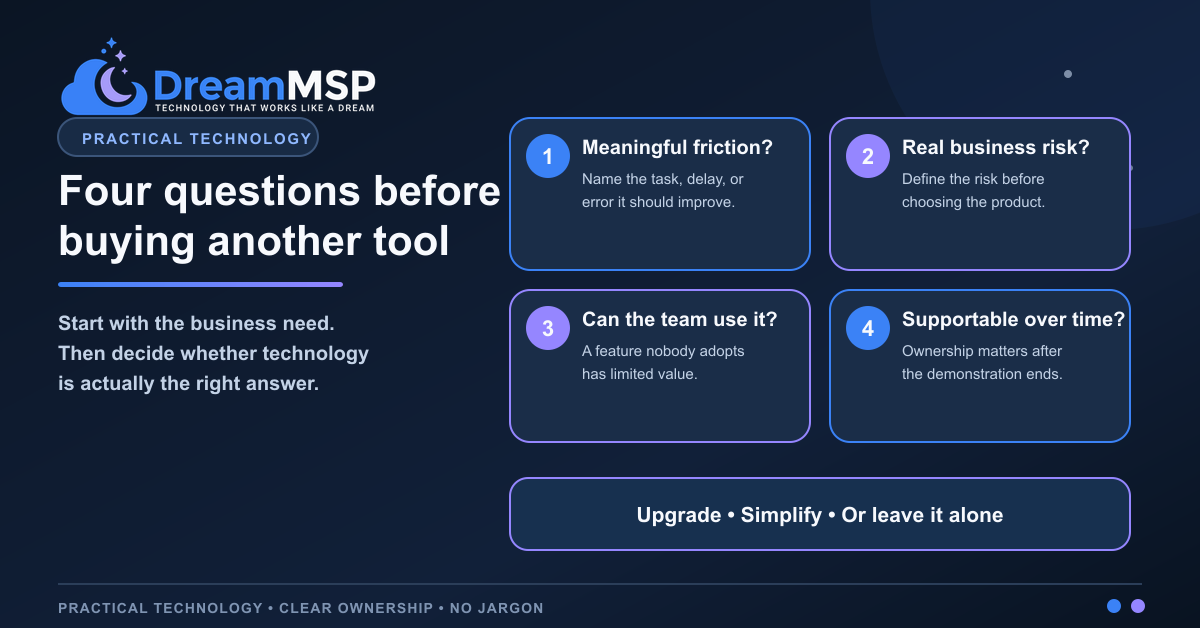
Four Questions Before Buying Another Tool
Before making the next technology purchase, I would ask four questions:
- Does it remove meaningful friction? Name the task, delay, or error it should improve.
- Does it reduce a real business risk? Define the risk before choosing the product.
- Can the team understand and use it? Include adoption in the design, not as an afterthought.
- Can it be supported over time? Assign ownership for administration, updates, access, documentation, and cost review.
If those answers are clear, the product has a fair chance of creating value. If the answers are vague, another demonstration will not make the decision better.
DreamMSP approaches technology planning this way because the business should remain the center of the decision. The technology is there to support the work, protect what matters, and reduce unnecessary interruption.
The business should not have to reshape itself around a tool somebody wanted to sell.