
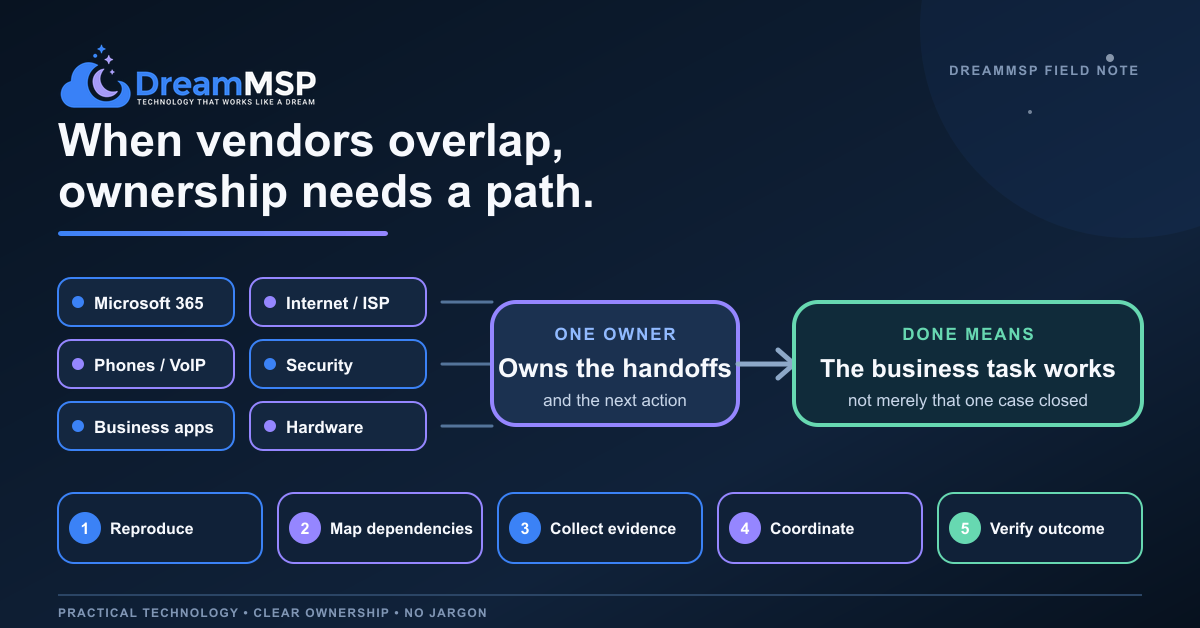
A surprising number of technology problems do not live neatly inside one product.
A scanner that stops sending documents by email could involve the scanner, the network, DNS, an authentication method, or a Microsoft 365 policy. A phone problem could begin with the handset, the local network, the internet circuit, or the phone provider. A business application may be running, the computer may be online, and the user may still be unable to do the work.
That is where support often becomes frustrating. Each vendor looks at its own piece, finds nothing obviously broken, and sends the business somewhere else.
Nobody has necessarily lied. Nobody has necessarily done poor work. But the business is still stuck.
The missing piece is ownership of the whole picture. Good IT vendor coordination gives the business one accountable technical lead when several providers are involved.
IT Vendor Coordination Solves Problems Between the Boxes
Technology vendors naturally understand the products they sell and support. The internet provider knows the circuit. The phone company knows its platform. A software vendor knows the application. Microsoft knows Microsoft 365.
The business does not experience those products separately. It experiences a workflow.
An employee signs in, opens an application, reaches data stored somewhere else, communicates through email or a phone system, and expects the result to reach a client or coworker. Several services may have to work together for one ordinary task to succeed.
When that task fails, asking whether each individual box is online is only the beginning. Someone still has to understand the dependency between the boxes.
That should not fall to the office manager, the business owner, or the employee who happened to report the problem. They should be able to explain what they were trying to accomplish and what happened instead. The technical investigation belongs with the people responsible for the technology.
IT Vendor Coordination Is Technical Work
Vendor coordination is sometimes dismissed as making a few phone calls. Done properly, it is part investigation, part documentation, and part follow-through.
The first job is to describe the actual business failure. “The internet works” is not enough if the application still disconnects every afternoon. “Email is up” does not resolve a scanner that can no longer deliver invoices. The symptom, timing, scope, and business impact all matter.
The next job is to map the dependencies. Which device started the request? Which network did it cross? Which identity or account was used? Which external service received it? Did anything change before the failure began?
Then comes isolation. A useful investigation tests boundaries instead of guessing. Does the same task work from another device? Does it fail for one user or everyone? Is the problem consistent or intermittent? What do the relevant logs, timestamps, and monitoring data show?
Only then is there a useful vendor handoff. The correct vendor receives a clear description, evidence already collected, the relevant account or service details, and a specific request for the next action. If the result points somewhere else, the investigation continues without making the client restart the story from the beginning.
The work is finished when the business workflow works again, not when one vendor closes its case.
Ownership does not mean pretending to control everything
The NIST Cybersecurity Supply Chain Risk Management program makes the same underlying point at a broader level: outside technology relationships create dependencies that still need to be understood and managed.
No managed IT provider controls every platform a business may use. A specialized software vendor may own its application. A carrier owns its network. A phone provider owns its service. Some equipment or operational systems may sit outside the agreed IT support scope entirely.
Owning the whole picture does not mean claiming expertise or authority that does not exist. It means being honest about the boundary while still helping manage the path across it.
That can include gathering technical evidence, opening the right support case, joining a call, translating between vendors, documenting the decision, and verifying the result inside the environment we do manage.
There are also times when the right answer is clear escalation. If a vendor must make the change, authorize the work, or troubleshoot its proprietary system, that responsibility should stay with the vendor. The managed IT provider’s role is to make sure the handoff is accurate and does not disappear into a queue without follow-up.
Clear ownership is not the same as unlimited scope. It is a commitment that the client will not be abandoned at the boundary.
Documentation keeps the investigation from starting over
Vendor coordination becomes much easier when the important facts are already documented.
That includes the provider name, support number, account identifier, authorized contacts, service address, important renewal dates, and the systems that depend on the service. It should also include recent changes and the location of the technical details a qualified person may need.
The purpose is not to collect information for its own sake. The purpose is to avoid wasting the first hour of an outage searching old email for an account number or trying to remember who is authorized to speak with the carrier.
Documentation also preserves continuity. The next technician should be able to understand what happened, what was tested, which vendor was contacted, what that vendor changed, and how the result was verified. The client should not have to repeat the same history every time the ticket moves.
This is one reason I consider documentation part of managed IT rather than an optional administrative task. It makes technical ownership repeatable instead of dependent on one person’s memory.
A good handoff gives the next person something useful
“It still doesn’t work” may be accurate, but it is not enough for the next support team to act efficiently.
A useful handoff answers a few practical questions:
- What business task failed, and what was the impact?
- When did it happen, and who or what was affected?
- What has already been tested?
- Which devices, accounts, services, or recent changes may be involved?
- What evidence is available, including timestamps, error messages, or logs?
- What specific action or answer is needed from the receiving vendor?
This is not about creating paperwork before helping someone. Work can begin immediately while those facts are collected. The goal is to stop weak handoffs from adding another round of delay.
A good handoff lets the next person continue the investigation. A poor one makes the client become the messenger between two support desks.
What a business should expect from managed IT
A managed IT relationship should give the business one dependable place to start, even when another vendor ultimately performs part of the work.
The person reporting the problem should know who owns the next action. The business should receive an understandable update when responsibility moves. If there is a delay, someone should be tracking it. If the issue is outside scope, that should be explained plainly rather than hidden behind jargon.
Most importantly, the final check should return to the original business outcome. Can the employee send the document? Can the call be completed? Can the application stay connected? Can the work continue?
That standard is more useful than counting how many vendor tickets were opened or how quickly one component was declared healthy.
The goal is less coordination work for the client
Most small businesses do not need another technology product simply because their vendors are difficult to coordinate. They need clearer ownership of the systems they already use.
That is the kind of managed IT service I want DreamMSP to provide: understand how the pieces fit together, keep the important information current, communicate honestly about boundaries, and follow the problem through to the business result.
The client should not have to become the project manager for every technology problem.
If your team spends too much time translating between technology vendors, our managed IT support page explains how we approach ongoing ownership. You can also read what to expect from managed IT services on Long Island for a broader view of the relationship.